
By Hyacinth Nwafor
The Director General of the Nigerian Maritime Administration and Safety Agency (NIMASA), Dr Dayo Mobereola has called for digital transformation as a catalyst for increasing the number of women participation in the maritime industry.
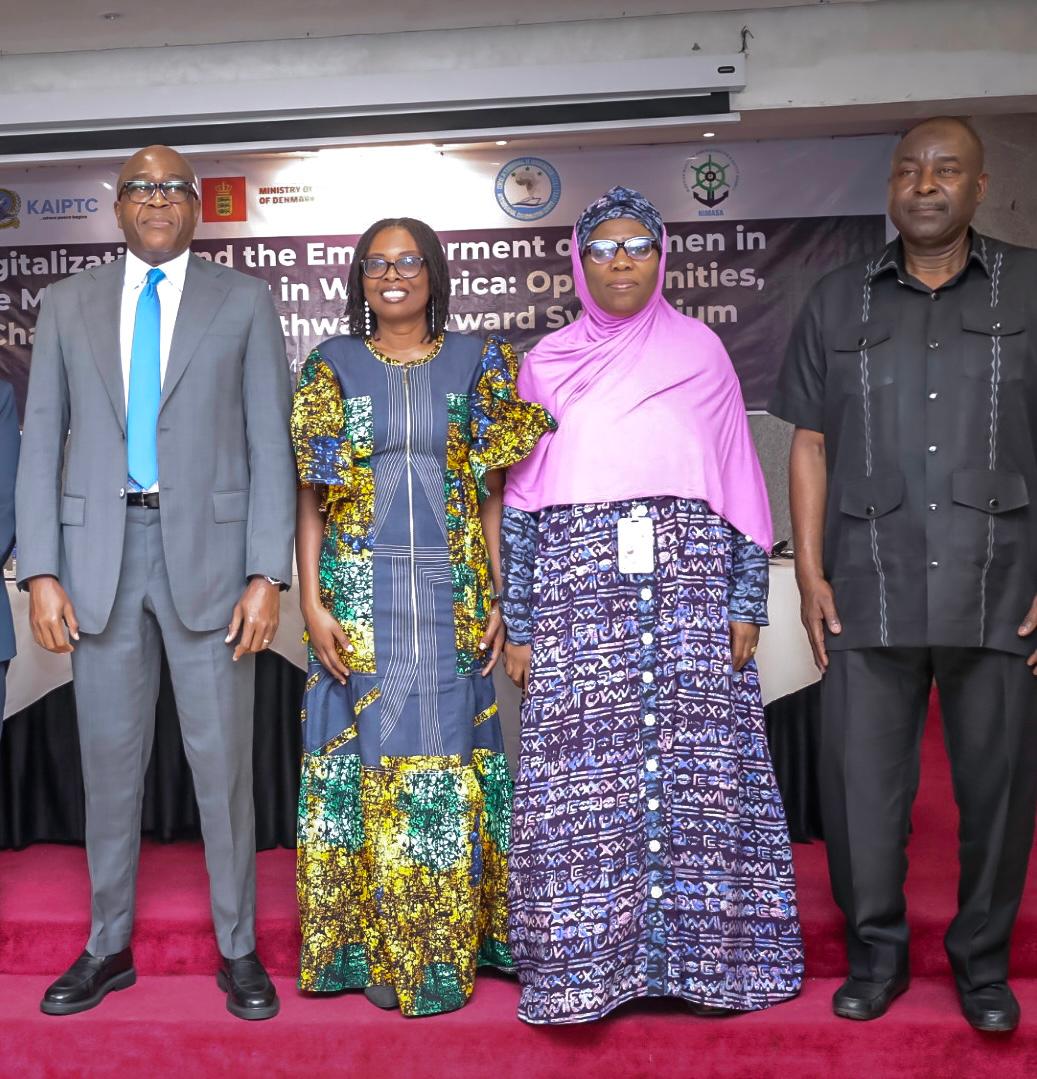
According to a statement signed by the Deputy Director/Head, Public Relations, Mr. Osagie Edward, FNIPR. Dr Mobereola said this in Lagos at a regional symposium organized by NIMASA in collaboration with the Kofi Annan International Peacekeeping Training Centre (KAIPTC), Ghana on “Digitalization and the Empowerment of Women in the Maritime Sector of West Africa: Opportunities, Challenges and Pathways.”
The NIMASA DG who was represented by the Agency’s Executive Director, Finance and Administration, Chudi Offodile, noted that digitalization is capable of significantly correcting the imbalance of women under representation in the maritime industry through the creation of new opportunities and removal of traditional barriers.
According to him, “Digitalization acts as the great equalizer, shifting the industry’s centre of gravity from physical strength to intellectual agility and technical precision. Through digital platforms and e-learning systems, a young woman in a rural West African town can access the same training modules as anyone in the more advanced parts of the world”.
Dr Mobereola noted that “Our maritime sector is undergoing profound transformation driven by digital technologies, automation, data systems and smart logistics. Across the world, digitalization is reshaping how ships operate, how ports function and how maritime administrations regulate and deliver services”.
He reaffirmed the Agency’s commitment to inclusive maritime development emphasizing that Nigeria is determined to ensure that the maritime sector becomes a benchmark for gender-inclusivity and digital excellence in the region.
In his remarks, the Deputy Commandant of KAIPTC, Brigadier General Zibrim Ayorrogo Bawah, highlighted the strategic importance of the Gulf of Guinea maritime domain and the need to ensure that women play a greater role in shaping its future, particularly in the era of digital transformation.
He noted that “Women’s participation in maritime affairs has historically been limited by socio-cultural and institutional barriers, yet their involvement brings diverse perspectives and solutions vital for holistic maritime governance”.
The symposium supported by the Ministry of Foreign Affairs of Denmark and the Inter-Regional Coordination Centre for Maritime Safety and Security in the Gulf of Guinea (ICC), brought together senior government officials, maritime professionals, academics, women’s groups and members of the media from across West Africa to deliberate on strategies for strengthening women participation in the maritime industry through digital transformation.
Participants at the symposium are expected to examine key issues including digital innovation in maritime governance, gender inclusion in maritime security operations, capacity building for women in digital maritime skills, and policy frameworks that promote gender equality and advance women empowerment across the Gulf of Guinea region.
The engagement is also expected to strengthen collaboration among regional and international stakeholders in advancing inclusive and sustainable maritime development in West Africa.