
Esther Oseyiomon
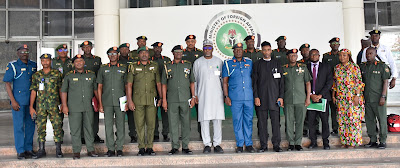
The Federal Ministry of Foreign Affairs on Tuesday hosted a delegation from the National Defence College of the Ugandan Peoples’ Defence Forces (UPDF) in Abuja, in a move aimed at strengthening bilateral cooperation on defence, diplomacy and regional security between Nigeria and Uganda.
The visit formed part of the Ugandan delegation’s study tour to Nigeria and provided a platform for strategic discussions on regional peace, counterterrorism efforts, institutional development and Africa’s evolving role in global affairs.
The delegation was received by senior officials of the Ministry led by Ambassador Musa Sani Nuhu, Director of the Policy Research and Statistics Department; Ambassador Ali Gombe, Director of the African Affairs Department; and Brigadier General Lawal Idris, Defence Liaison Officer at the Ministry of Foreign Affairs.
Speaking on behalf of the Minister of Foreign Affairs, Ambassador Bianca Odumegwu-Ojukwu, Ambassador Musa Sani Nuhu described the visit as a reflection of the longstanding friendship and growing strategic partnership between Nigeria and Uganda.
He also conveyed Nigeria’s condolences and solidarity to the governments and people of Uganda and the Democratic Republic of Congo over the recent Ebola outbreak that reportedly claimed more than 130 lives.
According to him, Nigeria stands with both countries during the difficult period and prays for the repose of the victims, speedy recovery of those affected and comfort for grieving families.
In his remarks, Ambassador Ali Gombe reaffirmed Nigeria’s commitment to deepening bilateral relations with Uganda, while congratulating the East African nation on its peaceful political transition.
The engagement featured extensive discussions on diplomacy, regional peace and security, terrorism, climate change, global power transition, regional integration and Africa’s position within the changing international order.
As part of the session, Brigadier General Lawal Idris delivered a presentation titled “Adaptation to Global Power Transition: Nigeria in Perspective,” where he examined the implications of the emerging global order on Nigeria, Africa and the wider sub-region.
He identified economic diversification, defence modernisation, technological innovation, regional cooperation and human capital development as critical strategies needed for African countries to adapt effectively to the evolving multipolar global system.
Discussions also focused heavily on security challenges confronting the Sahel and Lake Chad Basin regions, including terrorism, unconstitutional changes of government, violent extremism and the growing need for multinational collaboration in combating asymmetric threats.
Officials of the Ministry reiterated Nigeria’s commitment to democratic governance, intelligence sharing and regional peace initiatives, particularly under the framework of the Multinational Joint Task Force (MNJTF).
Participants further exchanged views on the impact of climate change, transhumance-related conflicts, youth unemployment and maritime insecurity on stability and development across Africa.
The Ugandan delegation expressed appreciation to the Nigerian government, the Ministry of Foreign Affairs and the Armed Forces for the warm reception and productive engagements during the study visit.
The event concluded with the exchange of gifts between both sides as symbols of friendship, cooperation and shared commitment to regional peace and development.