
•How pro-Russian, coup supporting “activists” were exposed, discredited
•Why Nigeria, ECOWAS deployed troops
•Waning democratic governance, a threat to West Africa
By Oumarou Sanou
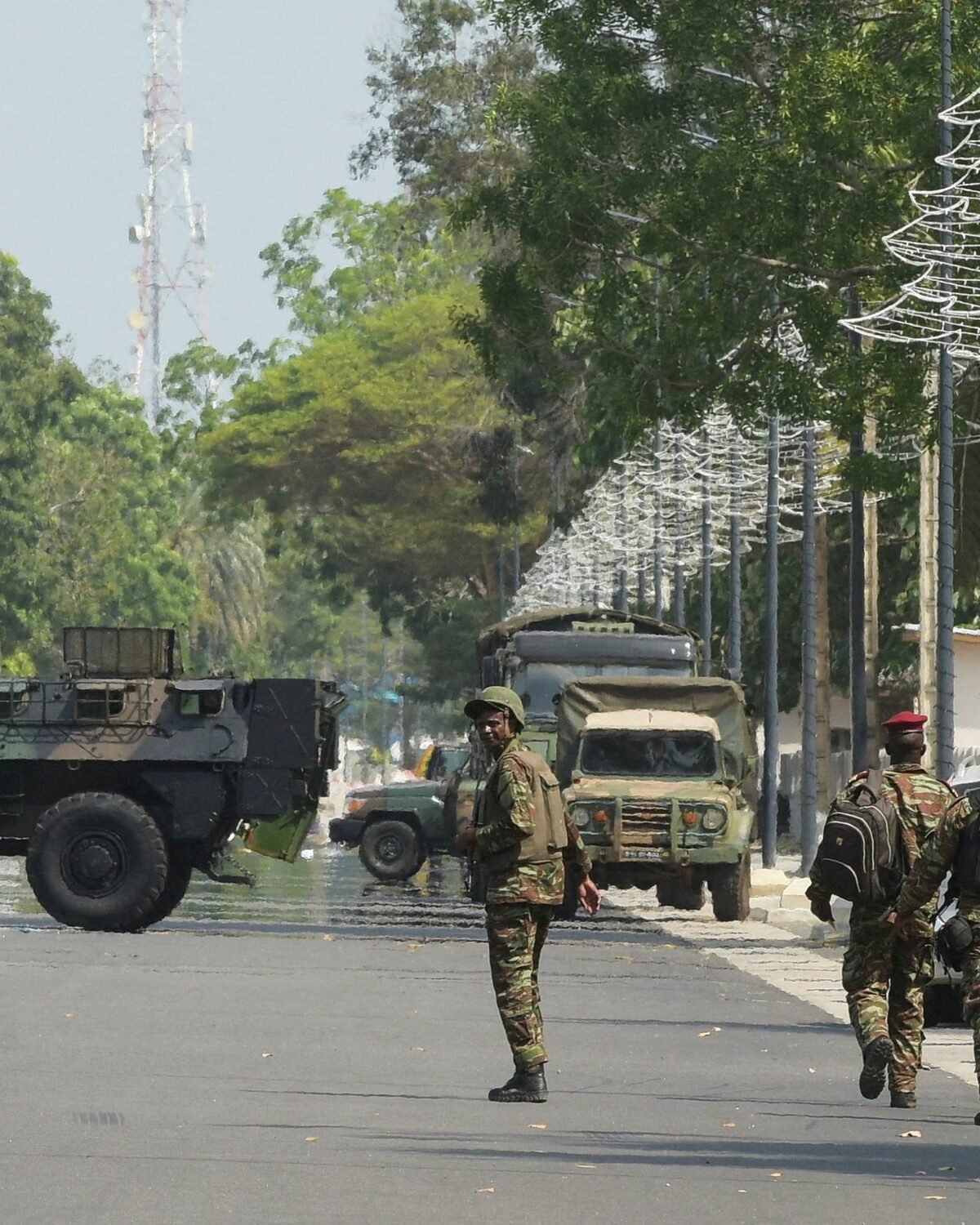
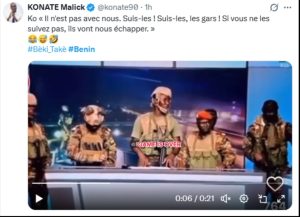
Shortly after dawn on Sunday, December 7, 2025, Benin’s usually calm capital, Cotonou, woke to the crackle of gunfire. A small group of mutinous soldiers launched a coordinated assault on President Patrice Talon’s private residence in the Guézo district before attempting to seize the presidential palace. Around the same time, another team stormed the national broadcaster, ORTB, where they announced the formation of a “Committee for Military Refoundation” under the little-known Lieutenant-Colonel Tigri Pascal.
Within three hours, the rebellion had collapsed. By 10 a.m., loyalist forces had retaken the palace and reclaimed the broadcaster. At exactly 12:30 p.m., Benin’s Interior Ministry appeared on television to declare the coup “completely defeated.”
The mutineers scattered. Several fled toward the borders. Calm returned. But the significance of the failed coup does not lie in its short duration. It lies in what it revealed.
This was not just the misadventure of a handful of soldiers—it was a case study in how foreign influence, digital manipulation, and democratic fragility intersect to create windows of vulnerability across West Africa.
A Suspiciously Synchronised Disinformation Burst
Even before official channels confirmed what was happening, the online information environment lit up—not organically, but with remarkable coordination.
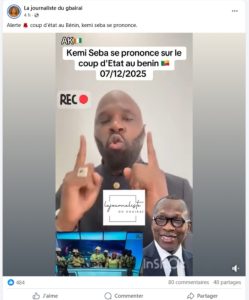
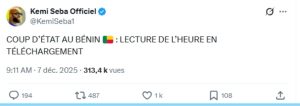
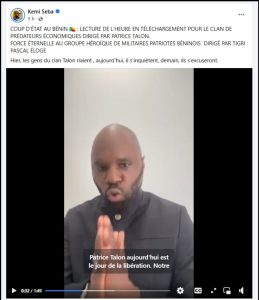
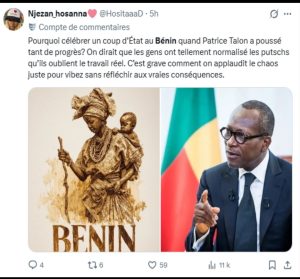
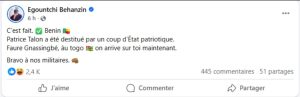
A chorus of pro-Russian “pan-Africanist” activists, many previously linked to Moscow’s information networks, sprang into action, including Kémi Seba, a prominent figure in Russia’s Africa outreach, who hailed the attack as a “day of liberation,” then quietly deleted the post once the plot was unravelled.
Another was Nathalie Yamb, a Swiss-Cameroonian activist closely aligned with Russia and the Sahel’s military juntas, who spread unverified claims and insinuations. Her silence during the post-election unrest in her own country stood in stark contrast to her sudden interest in Benin.
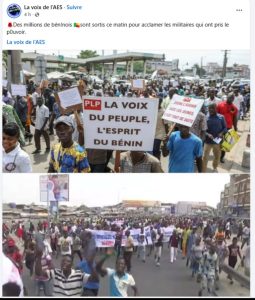
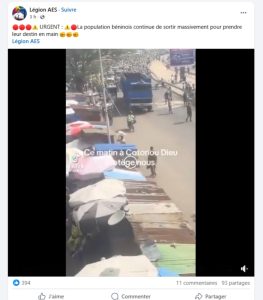
Additionally, accounts linked to the Alliance of Sahel States (AES)—a military-led bloc comprising Mali, Niger, and Burkina Faso—circulated doctored videos, fabricated images, and claims of “two million protesters” supporting the mutineers.
Recycled footage from old patriotic rallies was falsely presented as real-time mobilisation in Cotonou. This was not random noise. It was an information operation primed for exploitation—one that appeared ready-made and waiting for a trigger.
The speed and uniformity raised serious questions: Were these influencers briefed in advance? Were the AES-linked accounts acting on instructions? And were external actors anticipating a successful overthrow?
Russian Warships and Unanswered Questions
Perhaps the most puzzling development came from the sea. At the exact time the coup attempt was underway, two Russian naval vessels were detected approaching the Port of Cotonou. Witnesses say the ships abruptly turned away once it became clear the coup had failed.
Coincidence? Routine deployment? Something else? No conclusive evidence ties Moscow directly to the putsch. However, as security analysts often note, patterns matter. For instance, pro-Russian influencers quickly championed the coup, AES-aligned accounts amplified disinformation, and Russian ships moved in synchrony with the events.
In the same vein, the coup took place on the eve of a major pan-African meeting in Lomé—a moment of heightened strategic visibility. If not coordination, then convenient alignment.
However, one fact is apparent: the ecosystem that cheered the mutiny was overwhelmingly pro-Moscow.
Benin’s Institutions Held Barely
The most remarkable part of the story is not that the coup happened, but that it failed so quickly.
The Beninese Armed Forces, long regarded as professional and disciplined, remained united. Only a tiny and poorly organised faction joined the mutiny. Command structures held firm. President Talon remained secure under guard.
Public support was also decisive. Citizens came out in defence of the constitutional order. The attempted junta found no social base. This unity was reinforced by rapid signals from regional powers as Côte d’Ivoire alerted troops to stand by for intervention if Benin requested help. Gabon, despite its transitional military government, also indicated readiness to mobilise. Nigeria, as ECOWAS Chair, put regional standby units on alert.
For the first time in recent memory, West African states appeared willing to actively prevent a coup, not merely condemn one after the fact.

Nigeria and ECOWAS React
Fearing a repeat of what happened in Niger, Mali and Burkina Faso, Nigeria and ECOWAS took immediate and proactive steps to foil the coup with show of force and military deployment.
In response to the directive from President Ahmed Bola Tinubu, the Nigeria’s Ministry of Foreign Affairs issued a firm statement within hours:
“Nigeria condemns in the strongest terms the attempt to subvert the constitutional order in the Republic of Benin. Any unconstitutional change of government is unacceptable in West Africa. Nigeria stands ready to support Benin in safeguarding its stability, democracy, and territorial integrity.”
In the same vein, the ECOWAS followed with an emergency communiqué:
“The Authority of Heads of State and Government denounces the coup attempt in Benin and reaffirms its zero-tolerance stance on unconstitutional changes of government. ECOWAS urges all member states to strengthen democratic governance, address underlying grievances, and guard against external interference.”
These statements were backed by quiet but real military readiness, as some of the coupists were reportedly bombed and neutralised. The region clearly understood the stakes.

How Fragile Democracies Invite External Interference
The attempted coup exposed uncomfortable truths about West Africa’s democratic health.
Across the region, several trends make coups enticing—or at least easy to justify for populists, extremists, and foreign opportunists —such as the erosion of public trust in elections due to disputed polls, weak institutions, and corruption, which fuels cynicism.
Rising living costs and inequality, where economic hardship provides fertile ground for anti-government mobilisation, often commandeered by foreign-backed narratives. This is exacerbated by the shrinking civic space, where citizens cannot express their grievances peacefully, and unconstitutional actors step in. Then, the failure of regional early-warning systems, particularly within the ECOWAS and AU frameworks, focuses more on punishment than prevention.
Into these cracks enter foreign powers—Russia most aggressively—offering military partnerships, anti-West rhetoric, and propaganda support to coup-friendly actors.
In Mali, Burkina Faso, and Niger, Moscow-backed networks have reshaped the political environment, helping legitimise military rule under the guise of “sovereignty.”
Benin’s failed coup fits neatly into this pattern of attempted destabilisation—whether Moscow orchestrated it or exploited it.
A Region at a Dangerous Crossroads
The lesson from Cotonou is not one of triumph, but of caution. Benin narrowly escaped a crisis. Another West African state might not.
Suppose governments do not strengthen democratic governance, close civic space gaps, improve economic management, and maintain civilian control over the military. In that case, external and internal opportunists will likely attempt to do so again.
ECOWAS faces its most significant test yet: Can it restore deterrence and democratic credibility after years of failed interventions and weakened institutions?
The answer depends on whether it moves from reactive sanctions to proactive democratic peer review, as some experts have long advocated.

A Final Warning
Benin’s failed coup is more than a contained incident. It is a mirror held up to the region.
The Sahel’s coup contagion was not accidental—it was the result of democratic decay, citizen mistrust, security failures, and foreign manipulation. If these conditions remain unaddressed, West Africa will continue to be a playground for geopolitical proxies and destabilising forces.
Benin survived because its institutions held. But no country in the region today can claim immunity. West Africa must act—urgently, decisively, and collectively—before the next coup succeeds.
Oumarou Sanou, who contributed to this report is a social critic, Pan-African observer and researcher focusing on governance, security, and political transitions in the Sahel. He writes on geopolitics, regional stability, and the evolving dynamics of African leadership. Contact: sanououmarou386@gmail.com