
By Hyacinth Nwafor

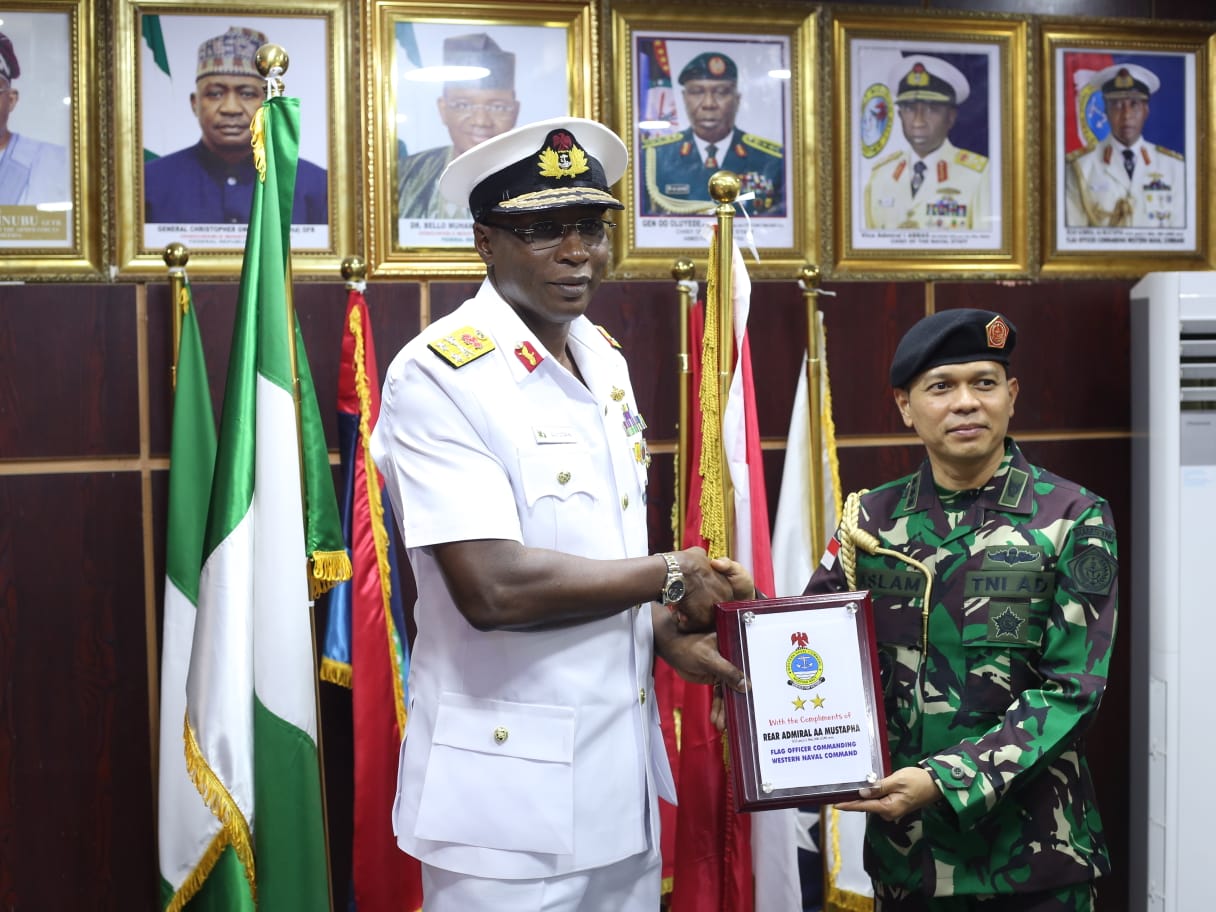
The Western Naval Command of the Nigerian Navy played host to a high-profile Indonesian naval delegation in Lagos, in what defence authorities described as a strategic milestone in deepening bilateral military cooperation. The visit, anchored on the maiden port call of Indonesian Navy Ship KRI Prabu Siliwangi 321, underscored growing maritime collaboration between Africa’s largest economy and Southeast Asia’s maritime giant.
In his opening remarks, the Flag Officer Commanding (FOC), Western Naval Command, Abubakar Abdullah Mustapha, formally welcomed the Indonesian delegation, describing the visit as “a testament to enduring bilateral relations and a signal of greater strategic convergence.” He noted that naval diplomacy remains a critical subset of national power projection and foreign policy engagement.
The Indonesian delegation comprised the Commanding Officer, officers and crew of KRI Prabu Siliwangi 321, alongside Indonesia’s Ambassador to Nigeria, Bangbang Suharto, and the Defence Attaché. The port call marks the first visit of the vessel to Nigeria in over three decades and symbolises Jakarta’s expanding strategic footprint in Africa.

Rear Admiral Mustapha, a seasoned naval officer with over three decades of service, highlighted his extensive academic and professional pedigree, including training at the Nigerian Defence Academy, the University of Plymouth, the Naval Postgraduate School, and the National Institute for Policy and Strategic Studies. He emphasised that the Command, as the premier naval formation, superintends over strategic coastal states from Lagos to Ondo, in addition to offshore and joint task force operations.
Tracing the diplomatic arc, both sides recalled that Nigeria and Indonesia have sustained cordial relations since independence in 1960. However, military ties received renewed impetus with the 2023 defence agreement, which formalised structured cooperation across the Army, Navy and Air Force components of both nations.
The FOC disclosed that Nigerian officers have undertaken capacity-building programmes at Indonesian defence institutions, while discussions are advancing in areas of maritime domain awareness, intelligence sharing and joint exercises. Indonesia’s participation in regional anti-piracy frameworks such as the Regional Cooperation Agreement on Combating Piracy and Armed Robbery against Ships in Asia and the Information Fusion Centre in Singapore presents, according to naval authorities, valuable intersections with Nigeria’s Falcon Eye and regional awareness capabilities.

On equipment and industrial cooperation, both parties identified shipbuilding and defence manufacturing as strategic frontiers. Indonesian advancements in naval platform construction, officials noted, offer Nigeria opportunities to strengthen its nascent military-industrial complex through acquisition, technology transfer and collaborative production.
Significantly, the visit is expected to culminate in joint sea drills, including Visit, Board, Search and Seizure (VBSS) manoeuvres and anti-illegal, unreported and unregulated fishing exercises during the frigate’s departure. The exercises, to involve Nigerian special forces, are designed to enhance interoperability and operational synergy between the two navies.
Present at the reception were key principal staff officers of the Command, including Fleet Operations Officer Captain G. Osweben; Command Transformation Officer Captain C.C. Osifu; Command Intelligence Officer Captain A.O.C. Ehanon; Commanding Officer Nigerian Navy Ship Aba, Captain Y.A. Shellen; Command Sports Officer Captain A.O. Umaru; Command Logistics Officer Commander A.U. Oji; Command Communications and Information Technology Officer Commander U. Njemanzi; Command Legal Officer Commander A.A. Oduole; and Commanding Officer Nigerian Navy Ship Guerrara, Captain U.F. Anthony.

Beyond strategy and sea power, cultural diplomacy also featured prominently. The Indonesian crew is scheduled to visit select cultural and traditional institutions in Lagos, reinforcing people-to-people ties. As Rear Admiral Mustapha concluded, the symbolism of the port call extends beyond protocol, it signals a maturing partnership poised to secure maritime commons, strengthen defence capacity and project shared stability across regions.
