
Esther Oseyiomon
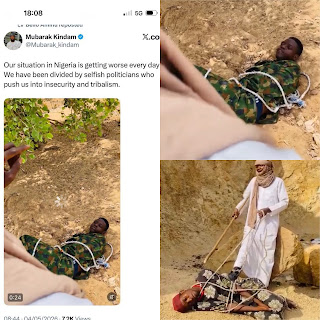
A viral video circulating on social media depicting a supposed Nigerian soldier captured by bandits has been dismissed as false and misleading, raising fresh concerns about the spread of misinformation and its potential impact on national security.
The video, created by a content creator identified as “Za Baba,” shows a staged scenario in which an individual mockingly portrays a tied-up soldier, using derogatory language to ridicule the military while glorifying bandits as “warriors.” The dramatized clip, widely shared online, has since been confirmed to have no basis in reality.
Findings indicate that there is no record of such an incident, with checks revealing that the video was entirely fabricated for entertainment and virality. The creator was also found to have used similar costumes in previous skits, alternating roles between a bandit and a soldier.
Security observers have described the content as not only misleading but also irresponsible, warning that such portrayals risk amplifying dangerous narratives at a time when the country is grappling with insurgency and banditry.
They noted that presenting criminals in a positive light while undermining the credibility of security forces could erode public confidence and inadvertently embolden hostile elements.
The development has also drawn attention to the role of social media users and bloggers, many of whom shared the video without verification, contributing to its rapid spread. Analysts say this reflects a growing trend where sensational but unverified content gains traction faster than factual reporting.
Authorities and security experts have stressed that while freedom of expression remains a fundamental right, it does not extend to the dissemination of content capable of distorting reality or undermining national security efforts.
They urged content creators to exercise greater responsibility, particularly when dealing with sensitive issues, noting that influence in the digital space carries significant consequences.
Members of the public have also been advised to treat viral content with caution and seek credible sources before drawing conclusions, as misinformation continues to pose a challenge in the information landscape.
The incident underscores the broader need for digital accountability, as Nigeria continues to confront complex security challenges requiring both operational efforts and responsible public engagement.