
Esther Oseyiomon
As security threats continue to evolve and military operations become increasingly interconnected, the Chief of the Air Staff (CAS), Air Marshal Sunday Kelvin Aneke, has urged emerging military commanders to prioritise collaboration, strategic thinking and innovation as the foundation for future mission success.
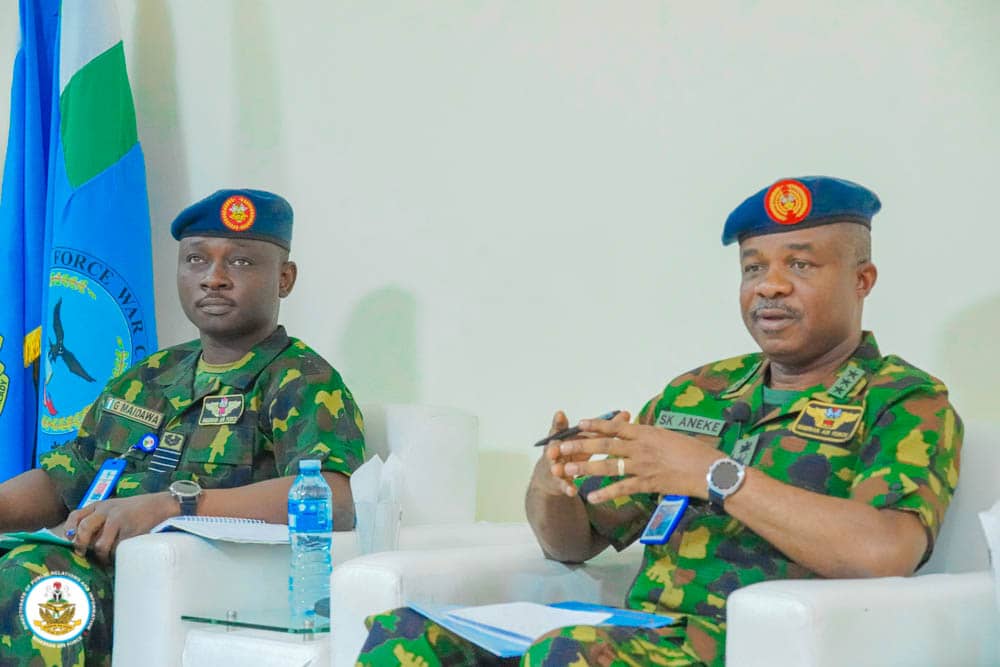
Speaking on Monday, June 29, 2026, at the Air Force War College Nigeria (AFWCN), Makurdi, during a lecture delivered to participants of Air War Course 12/2026, the Air Chief said modern warfare can no longer be won through isolated operations or Service-specific strengths alone.
Addressing senior military officers drawn from the Nigerian Air Force, Nigerian Army and Nigerian Navy, alongside allied participants from Botswana, Cameroon, Ghana and the Kingdom of Morocco, Aneke stressed that the changing nature of contemporary security challenges requires leaders capable of thinking beyond conventional command structures.
Delivering a lecture titled “Military Strategic Leadership: My Perspective,” the CAS argued that leadership in today’s military environment extends beyond issuing orders and managing operations. According to him, effective commanders must be able to inspire personnel, shape institutions and translate national security objectives into measurable operational outcomes.
He described synergy among the Armed Forces as an operational necessity rather than a choice, warning that fragmented responses weaken military effectiveness in complex theatres.
“Synergy is not optional; it is a strategic necessity,” he told participants, explaining that integrated planning and coordinated execution allow military formations to deliver outcomes beyond the capability of any single Service operating independently.
Air Marshal Aneke also linked this approach to his broader Command Philosophy, which focuses on building a highly motivated, professional and mission-ready force capable of delivering effective airpower while working seamlessly with surface forces.
According to him, sustaining military advantage requires continuous investment in personnel development, mission-focused training, innovation, strategic partnerships and policies that prepare commanders for future rather than present threats.
He further challenged participants to develop qualities beyond technical competence, including ethical leadership, emotional intelligence and strategic foresight, noting that the strength of any military institution ultimately depends on the quality of its people.
The lecture ended with an interactive engagement between participants and the Chief of the Air Staff, with discussions centred on future warfare, interoperability and strengthening joint operations — a reflection of ongoing efforts to prepare the next generation of military leaders for increasingly complex security realities.