By Yechale Degu
Over the past seven years, a wave of military takeovers and unconstitutional changes of government has shaken six West African countries- Niger, Gabon, Burkina Faso, Mali, Chad, and Guinea- while persistent insurgencies in Sudan and Ethiopia have further undermined the sustainability of democratic governance in the Horn of Africa. Against this backdrop, regional organisations have played a critical mobilising role in safeguarding constitutional order. ECOWAS and IGAD, in particular, work to strengthen transboundary frameworks that promote democracy, legitimate transfers of power within member states, and collective responses to unconstitutional actions against governments, such as sanctions. Notably, IGAD has advanced its influence in the Horn of Africa by establishing a Regional CSOs Forum to foster joint collaboration among civil society actors, promoting democratic governance across the region, and conducting a Regional Governance Forum and introducing a Regional Transitional Justice Framework.
The past seven years have witnessed significant political experimentation in the Horn of Africa across political liberalisation, governance, peace and security, and trade and economic reform. Yet, the region closed 2025 in a state of profound instability. This turbulence has been compounded by intensifying geopolitical rivalries, Israel’s recognition of Somaliland as an independent state, the Iran-Israel and USA war, deepening internal crises in Sudan and Ethiopia driven by insurgent movements, and mounting tensions among rival political forces in Uganda, Somalia, and Djibouti. As we enter 2026, the region finds itself at a crossroads of global geopolitical competition, with new external actors including the Arab League, the Organisation of Islamic Cooperation, the Gulf Cooperation Council and Israel expanding their sphere of influence in the region that would possibly extend Middle Eastern tensions towards the Horn.
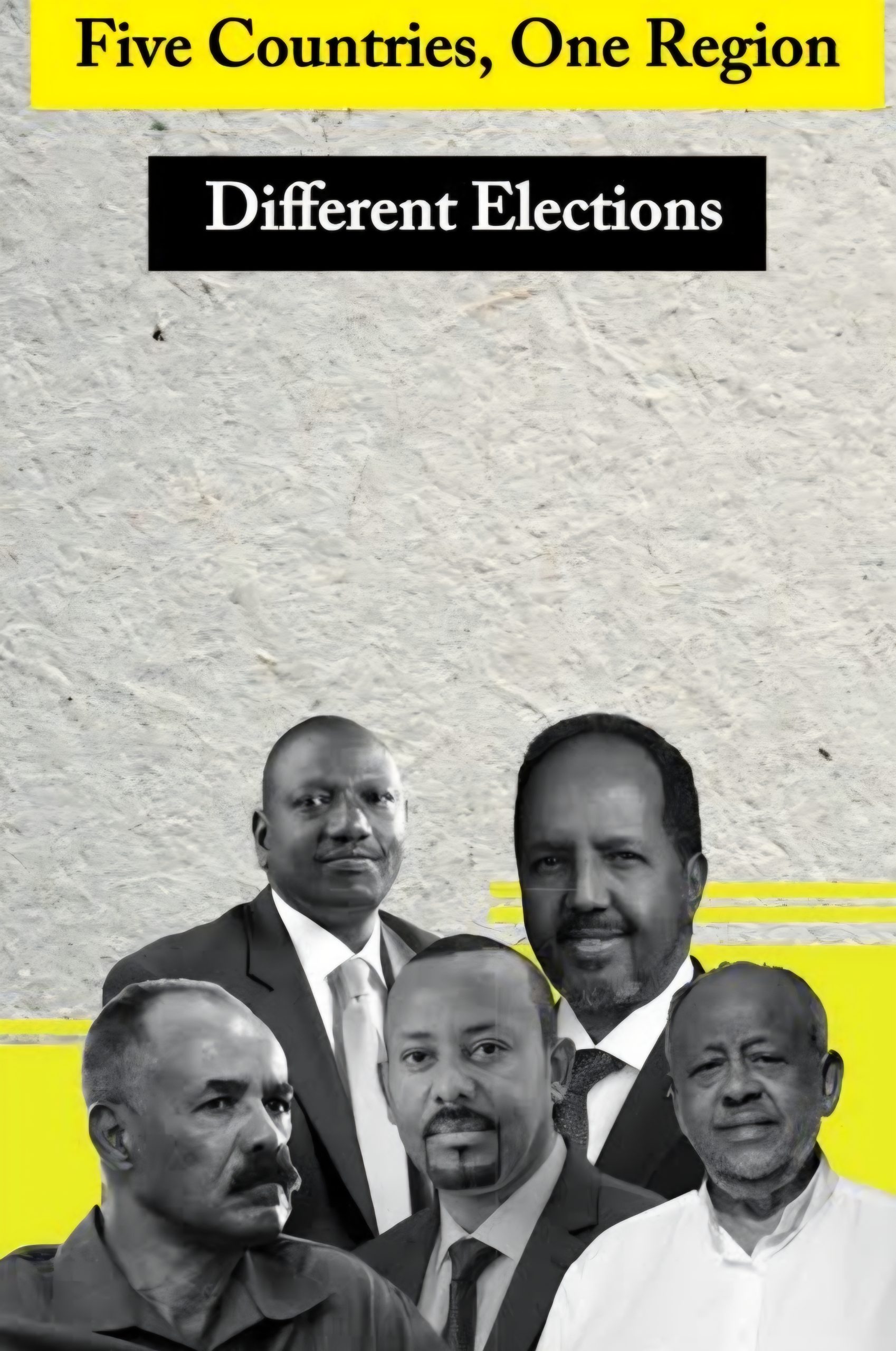
Amid declining global democratic indicators, the rise of right-wing populist governments in Western countries, weakening multilateralism, and reduced Western support for democratic practices in Africa, five of the eight countries in the Horn of Africa are scheduled to hold national elections in 2026. Somalia and South Sudan are preparing for elections later this year and in mid-year. At the same time, Uganda, Ethiopia, and Djibouti held their polls on June 1, January 15, and April 10 of 2026, respectively, which ended in landslide victories for incumbents.
This short article provides an overview of the region’s democratic landscape during a year marked by multiple elections, offering insights to guide development partners in addressing urgent regional democratic challenges
Despite substantial investments and international engagement for decades, democracy in the Horn of Africa remains far below the envisioned standard, varies significantly across countries, and is characterised by significant heterogeneity among member states. A closer examination of political trajectories reveals mixed outcomes. Kenya has maintained a comparatively robust framework of democratic governance. Yet, its elections are frequently marred by contested results, prolonged legal disputes, and post-election protests, sometimes violent, amid elite bargaining over power distribution. A notable achievement in Kenyan politics has been the gradual yet visible shift from ethnic-centred political mobilisation to state-oriented contestation. President William Ruto exerted tremendous political effort to evolve Kenyan politics towards a more issue-driven political culture, unlike anything in its political history. However, the sudden death of Raila Odinga, a long-standing figure in Kenyan politics and a critical power-balancing actor, on October 15, 2025, casts uncertainty over the competitiveness of future elections.
Ethiopia, continuing its political transition and reform process initiated in 2018, is scheduled to hold national parliamentary elections on June 1, 2026. However, ongoing insurgent activity in Amhara and parts of Oromia, coupled with renewed tensions between the Government of Ethiopia and Tigray People’s Liberation Front in Tigray, has cast uncertainty over the electoral environment and may disrupt voting in certain areas. Despite these challenging security conditions in Amhara, the decision to proceed with the elections reflects lessons learned from previous postponements that led to disastrous outcomes, including the outbreak of war in Northern Ethiopia. While delaying elections due to security concerns may appear reasonable, experience demonstrates that postponements without broad societal consensus risk plunging countries into political instability and even full-scale conflict
Somaliland, a de facto independent state recently recognised by Israel, has strategically employed democratic practices both to manage internal clan dynamics and to bolster its diplomatic efforts to secure broader recognition. Western diplomats and media often praise Somaliland as an “island of democracy” in the most eastern part of the Horn of Africa. Yet, while its democratic record surpasses that of Somalia and many others in the region, critics argue that recognition by a critical mass of states may diminish its investment and commitment to democracy, as it instrumentalises democracy as a bargaining tool rather than an entrenched governance principle. The Somaliland case underscores democracy’s role as a diplomatic instrument to normalise relations with states that champion democratic governance.
Somalia, in contrast, has struggled to consolidate democratic practices since the collapse of its central government in 1991. With IGAD’s support, Somalia initiated electoral processes intended to balance Somaliland’s democratic experiment and ensure its functioning in line with the transitional constitution. However, persistent clan rivalries and ideological disputes, particularly over whether to adopt a one-person-one-vote system or retain clan-based quotas, have hindered progress. Elsewhere in the region, democracy has regressed sharply. Sudan, Ethiopia, South Sudan, and Djibouti have all experienced setbacks due to factional power struggles. In Djibouti, constitutional amendments to extend President Ismail Omar Guelleh’s tenure have been widely criticised as a “constitutional coup,” exacerbating tensions between Afar and Somali Issa communities.
Eritrea remains an outlier, appearing as a totalitarian state without competitive elections since its birth. While stable under its autocracy, the country’s future requires an inclusive succession plan as President Isaias Afwerki enters his 80th year in a birth-year scorecard. Uganda presents a different trajectory. Though it has held consecutive competitive elections that attracted global attention, democratic governance has steadily declined due to crackdowns on opposition and civil society. There are allegations of internet blackouts, opposition, and activist harassment during January 15 2026’s election. Remarkably, the Horn of Africa hosts three states, Eritrea, Sudan, and South Sudan, that have never conducted competitive national elections since independence.
Generally, democracy in the region is critically short supply, as reflected in international and the Mo Ibrahim Foundation’s Africa reports. Despite commendable efforts by various actors, governance is found between fragile democracies and entrenched authoritarian regimes. Political transitions in Sudan (2019), Ethiopia (2018), and Kenya (2022) briefly raised hopes of democratic deepening, but subsequent reversals have dampened optimism. Kenya remains the most consistent example of democratic practice, followed by Somaliland, while other states continue to exhibit profound deficits, with Eritrea, Sudan, and South Sudan lacking even nominal elections.
The year 2026, however, stands out as a pivotal moment, with five states scheduled to hold parliamentary or presidential elections. Ethiopia and Somalia will hold parliamentary polls, while Uganda, Kenya, and South Sudan will hold presidential contests. Notably, South Sudan is preparing for its long-delayed first elections since independence in 201, originally scheduled for December 2026. Although prevailing conditions suggest these elections may fall short of fully meeting democratic benchmarks, they represent an opportunity to entrench democratic culture and renew optimism for governance reform across the Horn of Africa.