
By Michael Amajama
It is no longer a secret that countries around the world are taking steps to safeguard their sovereignty and peoples against disinformation from Russian intrusion. Though Russia argues against the obvious, its digital footprints are about and everywhere.
Little wonder that its neighbours are particularly ramping up efforts to bring their citizens up to speed on digital literacy and competence. The situation is so dire that in Finland which has a 830-mile border with neighboring Russia, a national curriculum for students as young as 3 years old, have been developed as part of a robust anti-misinformation program to make Finns more resistant to propaganda and false claims. Very telling!
It is not only the Finns that have taken measures against the propaganda blitz and disinformation of the Russians, Switzerland has raised the alarm, media monitoring on Swiss radio, WRS (Swiss Radio in English) indicates.
On January 8, 2026, the country’s defence minister, Martin Pfister, warned of a growing campaign of Russian disinformation targeting the country. Mr. Pfister accused Moscow of using so-called conspiracy narratives to undermine confidence in Switzerland’s neutrality, democracy and security.
Citing coordinated social media campaigns and hundreds of articles published each month by Russian outlets, Pfister said a strong and independent media is now a key part of Switzerland’s national security, while he gave a specific example of a recent video which was shot in Geneva. It was re-posted by several pro-Russian accounts, taken out of context, and supposedly shows Switzerland falling into chaos. He pointed out that the Russian platforms, Russia Today and Pravda, post 900 articles a month about Switzerland.
Africa is not exception to Russia’s propaganda and disinformation efforts. At the epic centre of its digital disruption tactics is Nigeria and the Sahel region. Nigeria for the obvious strategic importance of size, population and influence. The Sahel for its objective to have a stronghold and prop up authoritarian regimes that seem to have a stranglehold on press freedom, democracy and human rights.
Not too long ago, those behind the Russian propaganda efforts were caught pants down when a recently posted image on Facebook to highlight the beauty of Moscow: Modern skyscrapers towering above a marina with white luxury yachts in the soft glow of the golden hour was spotted to be false: The image was not taken in the Russian capital but in Dubai.
The German based media organization, DW, reports that the account from which the image was posted is known for regularly sharing pro-Russian content. Its owner, Vladimir Poutine (sic), features a profile picture of Russian President Vladimir Putin. However, according to some profile information, such as a phone number, the dubious account with over 180, 000 followers, seems to operate from the East African nation of Burundi.
According to the Africa Center for Strategic Studies in a 2024 report, Mapping a Surge of Disinformation in Africa, Russia continues to be the primary purveyor of disinformation in Africa, sponsoring 80 documented campaigns, targeting more than 22 countries.
It notes that this represents nearly 40 percent of all disinformation campaigns in Africa. “These 80 campaigns have reached many millions of users through tens of thousands of coordinated fake pages and posts. Aggressively leveraging disinformation is a mainstay of Russia’s use of irregular channels to gain influence in Africa.”
The Center makes the startling revelation that “Russia has promulgated disinformation to undermine democracy in at least 19 African countries, contributing to the continent’s backsliding on this front.”
With over 500 million Africans on social media in the past 7 years and over 600 million internet users on the continent and majority of these relying on social media platforms for consuming news, ranked at among the highest rates in the world, Russian deliberate news distortion finds a fertile ground for false and misleading information.
Further, the Instituto Español de Estudios Estratégicos in a paper The Russian Obsession: Disinformation and Propaganda in the Sahel by Ignacio Fuente Cobo in 2025 makes the point that Russian propaganda is a mixture of truth with manipulated or exaggerated, or simply false, information that seeks to generate uncertainty and make it difficult for the public to distinguish between truth and falsehood.
“Its main characteristic is the intention to persuade and mobilize a certain audience, whether internal or external, by openly using its state media such as RT and Sputnik, which present official narratives that serve to justify the government’s actions and dehumanize the adversary.”
It is for this reason that governments on the continent should step up their digital surveillance and invest in safe, secure digital public infrastructure or continue to see the erosion of democratic space, shrinking civic rights and instability as have been witnessed in the Sahel while propping the façade of an Eldorado.
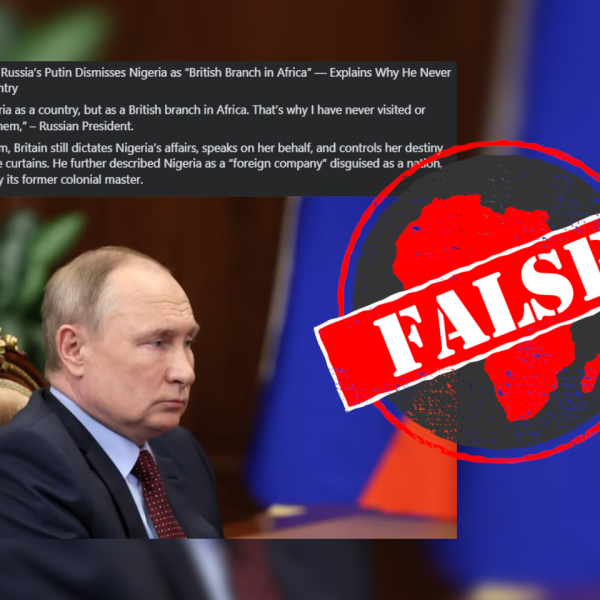
Knowing that it is investing in falsehood and the unattainable, the Russian Embassy in Nigeria and across the Sahel Region have tended to put a stamp of “fake news” when their efforts are spotted and called out. If it were to the contrary, it will demonstrate proof of what is authentic and not work to undermine efforts of genuine fact checking and human rights and democracy activists.
Its puppet in regime in Bamako adopting the repressive tactics of their handler, Moscow, in 2024 crackdown on the free press banning the media from reporting on activities of political parties and associations. The order, issued by Mali’s high authority for communication, was distributed on social media. The notice said it applied to all forms of the media, including television, radio, online and print newspapers.
Also, the military regime in Burkina Faso, another Russian asset in the Sahel, continues to clampdown on the media and banned over 13 new outlets including international news channels in the country. It has further been noticed that the Russian embassy in Nigeria has been flagging reports such as that of Oumarou Sanoua, a social critic, Pan-African observer and researcher, that exposes the depth of Moscow’s propagandist tendencies in Africa.
For Russia, diverse opinions and independent media are an anathema that should not germinate as they don’t fit into State Capture agenda of the Kremlin.
If anything, the Nigerian government in particular needs to be digitally aggressive in safeguarding democratic and civic spaces just as it commits men and resources to the protection of democracy as recently evidenced in Benin Republic. To do otherwise is give room to Russian infowars apparatchik to dominate the space, sow propaganda, create chaos and spread instability. The outcome is predictable and must be eschewed.
Amajama, a geo-politics analyst, writes from Abuja @ amajamaip@yahoo.com